Monday, October 26, 2015

Howloween

THE HORROR!:  Saturday morning the kids donned their Star Wars costumes again, and we headed to Experience Music Project for a special "Howloween" event.

Admission was free = awesome!

Here's Annabelle's short recap of the morning. 
On October 24, I went to EMP museum for “Howl-O-Ween”, an event where they had activities and such that you could do. The first thing we did was watch a small section of “Monsters Inc.” On the big Sky Church screen. We then got scavenger hunt sheets, which required us to look for things around the museum or answer trivia questions such as what the Wicked Witch of the West’s (from the Wizard of Oz) castle guards were named. Another activity we did was make Halloween bags and masks. We also participated in a costume parade where you’d come on stage and say what you were dressed as. Of course, we had to stop and play our favorite game: "Tenya Wanya Teens". It was very fun and I’d like to go again!

By the way, did you know these soldiers at the Wicked Witch of the West's castle were named Winkies? (Finding that out was part of our scavenger hunt.)

Here's what CJ had to say about Howloween

On October 24th, 2015, we went to EMP for their "Howl-O-Ween" event, where we would trick-or-treat* and fill out a sheet with trivia questions for a prize. The sheet has us answer different trivia questions, for example, what the name of the dragon in the "Fantasy: Worlds of Myth and Magic" exhibit**, and Kurt Cobain's 1993 Halloween costume, which was Barney the Dinosaur. On the back side of the sheet, we had to draw a monster, give it a name, and give it a favorite food. I named my monster "George," and said his favorite food was ribs. When I turned in the sheet, I got a stylized guitar pick as a prize. Lastly, there was a costume parade where we could get up on stage, say our names, and say who we were dressed as. I am dressing as Luke Skywalker this year for Halloween.
*By that, they meant crafts. I think it's a very loose definition of "trick-or-treating".
**In the exhibit, although there were signs talking about dragons, none of them mentioned this dragon's name. We asked the volunteer if he knew the name, but he said he didn't know, so mom had to Google the dragon's name. It turns out the dragon is named Adalinda, and she was donated to EMP by the North Seattle Opera.
While at EMP, we just *had* to visit the Horror Film exhibit, since it's almost Halloween and all. 
 We saw lots of cool monsters, props and costumes, including this famous suit from Michael Jackson's "Thriller" video.
And this friendly zombie ...

We spent some time in the Science Fiction portion of the museum, of course. With all of the "Back to the Future" stuff in the news recently, we had to stop and admire the hoverboard, of course. 
Here, the princess ponders a control panel.
I took this cool pic of the kids and Tweeted it.  
We were rather flattered by EMP's response ...
How 'bout that? :)

HOOPLA:  We recently took on a bit of a project. A couple weeks back we received an email from the school the kids attend a few hours a week asking people to be on the lookout for outdoor furniture and a portable basketball hoop for the playground. We happened to spot one on the Buy Nothing group we're a part of and a kind neighbor was nice enough to donate his hoop to the school. We had to go pick it up (it being about 12 feet tall, and made mostly of heavy steel), and transport it to our place. Once we had it here, we decided to service it, so that it will be trouble free for years to come at school.

We ground off rusty spots in the paint ...
and then repainted the pole a nice flat black.

We even fixed a couple of cracks in the backboard with some stinky epoxy (which worked really well, might I add), and then repainted the backboard (a nice flat white).
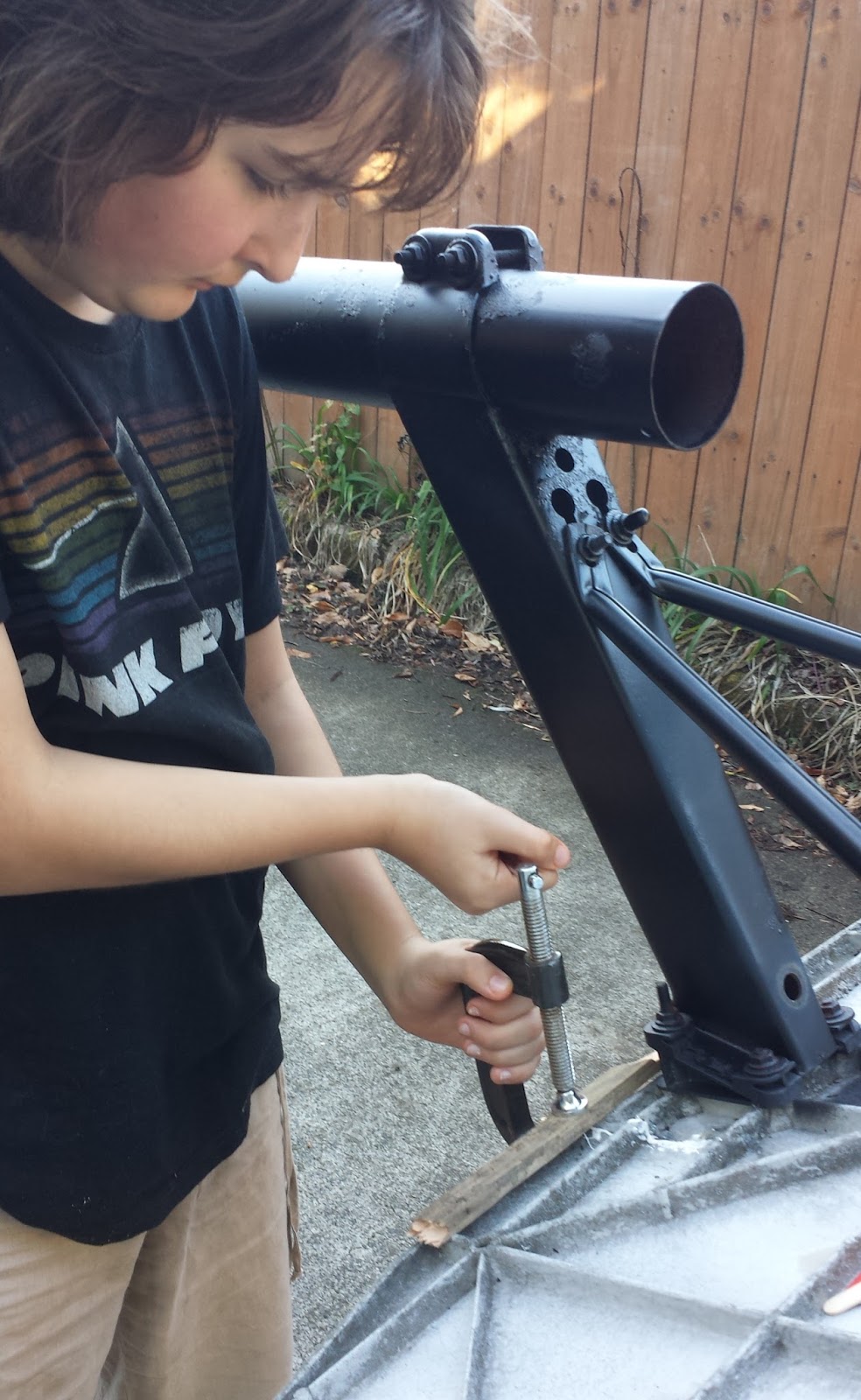
Christian and I delivered it to school early this morning and set it up. Hopefully, it gets a few more years of good use!

Thursday, October 22, 2015

The Future is Now

FRONT PAGE NEWS:  Count us among the legions of folks who watched "Back to the Future Part II" last night, as Oct. 21 was the day lead character Marty McFly traveled to the future. 

While there, one thing Marty did was read a USA Today dated Oct. 22, 2015, marveling at the headlines.

Today, we hit the newsstand and bought a commemorative, today only edition of that paper 

It's fun reading the headlines, which made mention of a female president (not yet), and the Cubs winning the 2015 World Series (they were eliminated from the post season last night).

One element USA Today publishers had to change from the movie prop was a headline that had had "Queen Diana" visiting Washington D.C. That possibility ended in 1997, when she was killed in a tragic auto accident.

PARK POSTERS:  We're still working our way through a stack of educational and attractive posters we got as part of an Earth Sciences week packed. For the last few days, we've had a couple of full color posters about our National Parks system on the wall.
I asked the kids to share a couple of things they learned about the NPS, and tell me what park they'd most like to go visit.  

Here's what Annabelle had to say. ... 
The National Parks Service is an organization dedicated to organizing and protecting national parks. National parks span the entire country and are located in almost every state. National parks also come in many different forms, from campsites to nature preserves. National parks are a great palce to visit if you are looking for a nice place to take a stroll. National parks can be loacted almost anywhere, including a building, as evidenced by the gold rush museum here in Seattle. One national park I would like to visit is the Olympic National Park, located on the Olympic Peninsula. 
        Credit: NPS photo
It has an overwhelming population of Roosevelt elk, the largest unmanaged population in the world. It was almost named “Elk National Park”, because it was founded in part to protect these elks. The park is very large and it seems like fun to explore. I would love to visit someday.
Credit: NPS photo Autumn Elk in the Hoh

And the following is CJ's take. ... 
The National Park Service is, according to Wikipedia, an agency of the United States federal government that manages all U.S. national parks, many American national monuments, and other conservation and historical properties with various title designations. In the United States, the primary goal of establishing national parks is to preserve their natural beauty for the public and future generations to see.
According to www.classzone.com, a place must meet the following 3 criteria to be considered to become a national park: 1: It must possess a unique natural, cultural, or recreational resource.2: It must be in need of protection, and no organization other than the National Park Service would be able to secure adequate protection.3: It must be able to be protected. (It is suitable and feasible to protect the area.)' I would like to visit the Mount Rainier National Park, which is located in southeast Pierce County and northeast Lewis County. 
Credit: NPS photo - Rainier from Paradise
The park is most well known for Mount Rainier, which is the highest mountain of the Cascade Range of the Pacific Northwest, and the highest mountain in the state of Washington. The park also has the Wonderland Trail, which is 93 miles long, and there are several beautiful pictures of the park online. 


Carbon Glacier, which is in the park, is the largest glacier by volume in the contiguous United States, while Emmons Glacier, which is also in the park, is the largest glacier by area.
JUST WONDERING: As we took a neighborhood stroll this afternoon, we saw a home with an attractive display of gourds and squash on their porch. That got us to wonderin', what's the difference between gourds and squash? Annabelle did a little research, and it turns out, she says, "The main difference between gourds and squash is that squash is mainly grown for eating, while gourds are usually cultivated for display." 

From the Missouri Botanical Garden, we learned both gourds and squash are members of the enormously diverse Cucurbitaceae family, which contains more than 100 genera and over 700 species. 

We talked about how gourds have also had utilitarian purposes for centuries, hollowed out and used as bowls and other vessels. Annabelle noted that a character in a book she's reading, "A Single Shard" has a gourd bowl.

Wednesday, October 21, 2015

On Solid Ground


DOWN ON THE FARM:  The kids are involved in a social issues class that meets twice weekly. The group is focusing on hunger at home an abroad, and ways to combat it. That led to us volunteering at a food bank last week, and this week, it meant a field trip to a local farm that grows produce that is distributed to 27 food banks in the area, Marra Farm.

We gathered under this tree and learned lots about the farm from a worker. 
Located in the South Park area of south Seattle, once upon a time the Marra family, Italian farmers, worked the land from the early 1900s until the 1970s, when they sold it to King County. 

Today, Marra Farm is one of the last two remaining pieces of original agricultural land in Seattle.
Today, Marra Farm addresses community food security needs, provides a space for sustainable agriculture education, and engages community members in a myriad of ways.

Following is Annabelle's account of the field trip ...  
On October 20, I went to Marra Farms. Marra Farms is part of the “Lettuce Link” program, which is focused around getting fresh vegetables to those in need. Marra Farms is also part of the Solid Ground organization, which focuses on getting home, food and other necessitates for people in poverty. Marra Farms grows many different kinds of veggies, including chard, beets, asparagus, lettuce, tomatoes, and many more. They also grow a few fruits such as apples and plums. The amount of veggies the farm produces (about 15,000 pounds a year) 500 pounds of veggies could almost fill a van, but it could be used up at a food bank within less than a day. Some people also grow food in a p-patch to feed their own families. They also have a children’s farm where students from the school around the block come and use gardening to tie in with their classes (for instance, the science class could do an experiment where they watered one plant with water and the other with orange juice). They also raise bees and chickens on the farm, to produce fresh eggs and honey. The farm is a very interesting place to visit and I can’t wait for our next field trip, where we will learn more about the history of the farm.
 And here's what CJ had to say ... 
On October 20th, 2015, we went to Marra Farm, an urban farm, which, according to the Solid Ground website, is a historic urban community farm engaging people in sustainable agriculture and education while enhancing local food security. We went to Marra Farm as part of our field trip in our Social Issues Class at my school. Marra Farm is a part of Lettuce Link, a program dedicated to feed hungry people living in Seattle. Lettuce Link is a part of Solid Ground, an organization, that, according to the Solid Ground website, is an organization that fights poverty in Seattle.
According to the City of Seattle website, Marra Farm is inside the Marra-Desimone Park. At Marra Farm, we learned that the farm produces 15,000 pounds of vegetables every year. Marra Farm also has a greenhouse, which is where they grow plants during periods of the year that aren't very plant-friendly, such as winter. Marra Farm also has a hive for honeybees, and the primary reason they own honeybees is so they can pollinate certain flowers. We also learned other things at Marra Farm, such as the subtle difference between chard and beets, which are closely related, and we learned that beet leaves are edible. Overall, I learned a lot from our visit to Marra Farm, and I look forward to our next visit on the 27th.
Sources: http://www.seattle.gov/neighborhoods/p-patch-community-gardening/p-patch-list/marra-farmhttp://www.solid-ground.org/programs/nutrition/marra/pages/default.aspx
BACK TO THE FUTURE: If you were online today, likely you saw mention that it's *the day* that was pivotal in our history. Well, at least cinematic history. ... As a White House press release noted, "It's the date to which Marty McFly traveled into the 'future' in Back to the Future Part II."

The press release also noted, "We've come a long way in the 30 years that have passed since the original Back to the Future came out. Now, we're going to talk about where we're going in the next 30.  All day long, we're hosting a series of conversations with scientists and innovators across the government and the country. You'll be able to ask them questions, watch videos explaining their cutting-edge developments, and share your answer to the question above: What does 2045 look like?"


I thought I'd let the kids ponder that for a few minutes and come up with a paragraph about it. 

Here's what Annabelle had to say. ... 
30 years from now, computers will be one of the only sources of communication and information. Talking face to face will be replaced with "Skypeing", and YouTube will triumph over real-life stage plays and other entertainment. The video game market will boom, especially due to the rise in virtual reality. Video games will have become as immersive as ever, such as jumping and causing your character to jump. Gaming will even be a professional sport, with even more tournaments than there are currently. We can have robots do most of our work, but some tasks require human input. Even humans have been robotized, being quote-unquote “cyborgs”, where they have an ID chip implanted in them (much like a dog’s ID microchip). The chip would also offer wi-fi, no matter where you are. The entire world might even have internet connection. The internet will surely be a major part of our future, judging by the fact it’s already so large.
And here was CJ's take ... 
30 years from now, several different technological advancements will have been made. Multiple rich business-people around the world will own hydrogen-powered vehicles, and self-driving cars are beginning to be phased in. The virtual reality industry will be worth billions of dollars, and the third manned mission to Mars will have been launched. Several people have implants resembling the Google Glass and Apple Watch, but either surgically fused to them or placed internally.


Tuesday, October 20, 2015

Mid-October Merriment


CAKENSTEIN:  October means a bunch of birthdays in the family, including Annabelle, who turned 11 this year. 

She gets to choose what kind of cake she wanted, and this go-round she opted for a robot shaped cake based on a character created by singer songwriter Morgan Taylor, whom she, CJ, and a few other lucky Seattle kids took a wonderful week-long workshop with this past summer. 

Here's a video all about the cakey monster


The song calls for a pink cake, and I recalled pink champagne cakes of years gone by. (I think they were a pretty big deal in the '80s!)  That sounded good to Annabelle, and so she popped some bubbly (to be used as an ingredient in the cake batter). Maybe I'll buy her a bottle of pink champagne for her birthday 10 years from now. :)
We made six little layers of cake, ranging in diameter from six inches for the base to the size of a tuna can for the head.
Rice Krispie treats were necessary for Cakenstein's arms and for his detonator/energizer switch. 

We made a whole lot of gray fondant, and a little red (for his cherry eyes), and a bit of blue (for the cakey babies' blueberry eyes).
We baked and built the whole thing in one day, pretty much. Not bad for a multi-tiered cake monster with cakey babies. :)

PATCHY:  Mid-October also means it's about time to be hitting up a local pumpkin patch. For several years running, we've tried to go to different places. This year's new-to-us destination was Dr. Maze's Farm, in Redmond, WA, just about a half hour east of Seattle.

Dr. Maze's was founded in 2010, and it's part of a group of neighboring farms that created The South 47 Farm, which works to protect farmland and promote sustainable farming.
 The moment we pulled into our parking spot, I started peering out the windows and asked, "What's that sound?" knowing full well that it was the noise of legions of winged creatures.

I can honestly say in my 50 years, I've never heard that much bird 'song' in one place, at one time. I found it rather frightening.
CJ, who is fortunate enough not to have seen Alfred Hitchcock's "The Birds," didn't seem frightened at all. Lucky boy.

With a bit of trepidation (at least on my part), we approached the admission stand. 
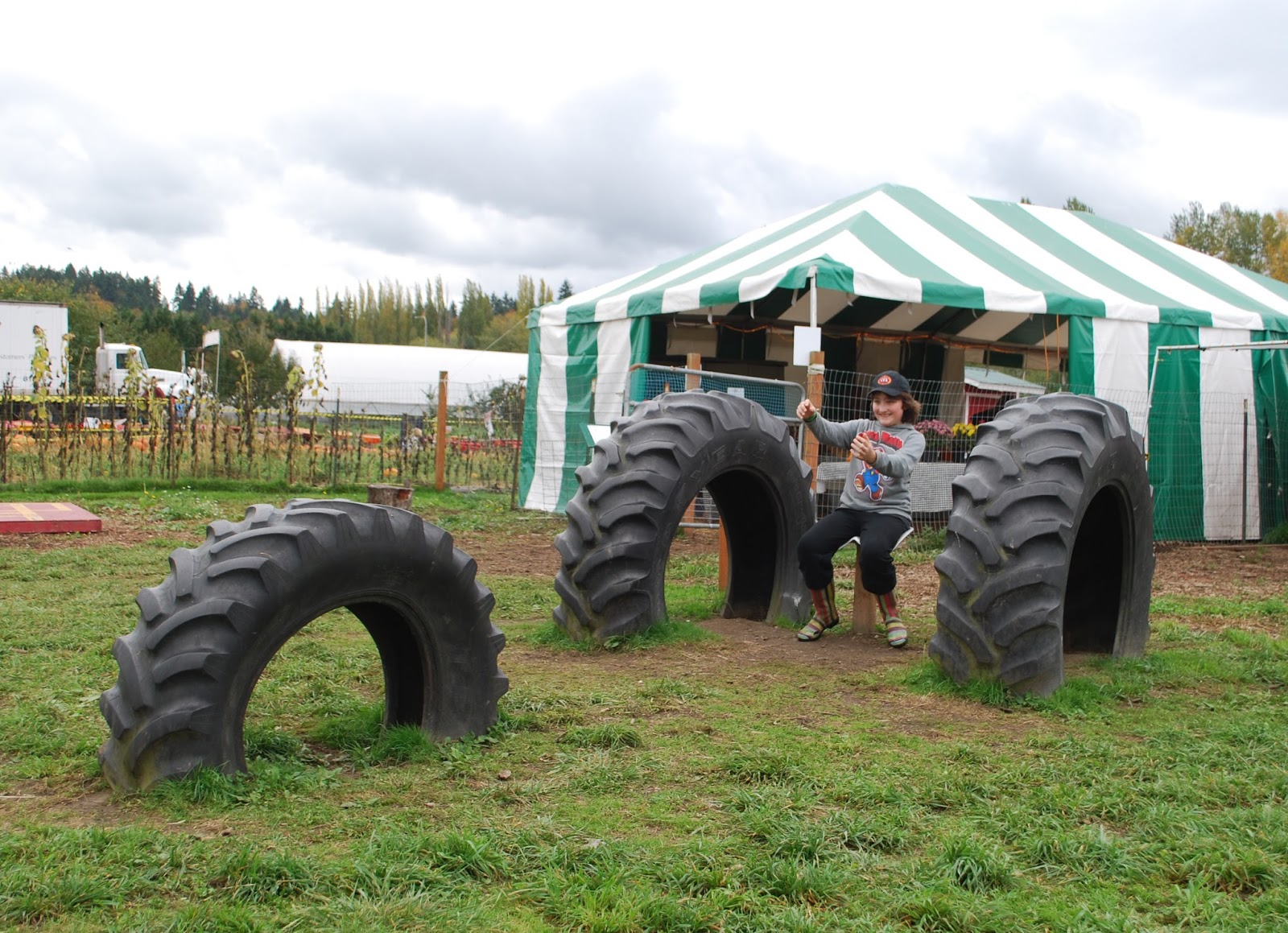
There were photo opps aplenty at Dr. Maze's.  The kids took a ride on a pumpkin truck ... 
and they got their American Gothic on.
CJ was a crazy driver of a virtual tractor. He sat there wishing he had on an Oculus Rift.
Once we headed into the maze, there were questions and puzzles awaiting. 
 The kids and Christian never could solve this one where they were supposed to start on red, then go green and then yellow, in that order and work your way to the end. 
 We did, however, easily find the end of the maze.
Outside, the kids played giant Jenga.

And they made some music.
Speaking of music, there was an entertaining animatronic chicken chorus.
CJ was a huge fan. After the rest of us had moved on, I caught him over by the coop, doing the chicken dance. :) 

There were ponies to ride bareback.
It was big fun for the big kids. 
I sure am glad they don't think they're too old and cool for this stuff. :)

Monday, October 19, 2015

Spudtacular

YOU SAY POTATO: Another busy, busy weekend, with birthday celebrations, field trips and more. 

In fact, it was so busy, and we're so bushed, the big write up is going to have to wait. 

For now, I leave you with a potato. 

But not just any potato. It's a Martian potato. 

More specifically, a "The Martian" potato, a movie tie in.

A couple of weeks ago I saw a post somewhere mentioning that as a promotion for the recent movie about an astronaut stranded on Mars, the movie studio hired Mail a Spud, a company that, well, mails potatoes, to send out some special spuds with "The Martian" stamps.

The article I saw noted that the first 1,000 people who registered would get their spud for free!! That's right, a FREE potato!! It's like winning the lottery, pretty much!  (Normally it costs $10 to have them mail a potato for you.)

I immediately followed the (now disabled) link and ordered up a potato, hoping beyond hope it would be delivered in time for Annabelle's birthday, because who wouldn't want a potato for their birthday, right?!

Lo and behold, the United States Postal Service brought our specially stamped spud to our door on Saturday, just in time for Bee's big day. Hooray!

Fortunately, "The Martian" has posted instructions so we can grow potatoes from our "Martian" potato, just like Mark Watney did in the movie. Wish us luck!

Friday, October 16, 2015

It's Geologic!

MAPTASTIC:  We keep working our way through the huge packet of wonderful goodies we received a few weeks back, ahead of Earth Science Week. There were so many resources in the packet, it's taking more than a week to get through them, that's for sure. 

Recently, we've checked out posters about major extinction eras in our planet's history, plate tectonics, and geodsy ("the science of accurately measuring and understanding three fundamental properties of the Earth: its geometric shape, its orientation in space, and its gravity field— as well as the changes of these properties with time," definition per the National Ocean Service).

Today, we checked out a poster all about the rock types of the United States thanks to a poster from the American Geosciences Institute, which represents more than a quarter-million geoscientists.

One side of the poster featured a map of North America which was color-coded for geologic features of the land. Right away, the kids noticed that one of the colored categories of geologic types was plutonic rocks, and that they're plentiful in the Puget Sound region, where we live. They were pretty certain that the label didn't mean the ground in the areas was from Pluto, but we wanted to research the label.  


We hopped online and found an article on geology.about.com that told us that "plutonic rocks are igneous rocks that solidified from a melt at great depth. The name 'plutonic' refers to Pluto, Roman god of wealth and the underworld."

We learned that characteristics of plutonic rock includes tightly packed mineral grains of medium size (1 to 5 millimeters), with the grains being of roughly equal size. All of the mineral matter is in a crystalline form, and plutonic rocks typically look like granite. The reason they have large mineral grains is because they cooled over tens of thousands of years, or longer, and that allowed the individual crystals to grow large.

Studying the map, the kids also noticed a wide swath of the middle of North America was labeled as being siliciclastic. We turned to Google to find out more about that, and quickly found a lecture (in PDF form) all about the classification of sedimentary rocks, including clastic (siliciclastic), with subcategories of sandstones, mudstones (shales), and conglomerates.

When we flipped the poster over, we saw a banner headline that read "Celebrate Geologic Map Day! Friday, October 16, 2015." 
That would be today!

One item the poster prominently mentioned was that 2015 is the bicentennial celebration of first nationwide geological map. How 'bout that?!

The amazing map was made by William 'Strata' Smith (23 March 1769 – 28 August 1839).
An Englishman, Smith had a humble education and was not well connected socially. However, he knew his stuff!

Smith worked for mining companies and over time, became to recognize the different strata in land that had been excavated, and he realized that the combinations of distinctive fossils within a rock can be used to identify it. 

During his field work, Smith amassed an enormous and unique fossil collection, which he used as evidence to order his strata and make his maps. The Natural History Museum in the United Kingdom now has more than 2,000 of Smith’s fossils in their care.

Unfortunately, Smith's map was initially overlooked by the scientific community - and his work was frequently plagiarized. At one point, he was in such financial ruin, he spent time in a debtors' prison. Fortunately, Smith eventually received accolades for his work, and recognition for his accomplishments, and became known as the "Father of Geology".

You really should check out a big ol' image of Smith's history making map in this PDF from National History Museum in the United Kingdom

http://www.nhm.ac.uk/content/dam/nhmwww/discover/first-geological-map-of-britain/william-smith-1815-geological-map.pdf

We are rather fond of the official title Smith gave to his map: 
'A Delineation of the Strata of England and Wales, with Part of Scotland; Exhibiting the Collieries and Mines, the Marshes and Fen Lands Originally Overflowed by the Sea, and the Varieties of Soil According to the Variations in the Substrata, Illustrated by the Most Descriptive Names'.

Many things made the map remarkable, one being Smith's innovative use of color and shading to represent each rock layer. In all, he had twenty-three strata, meticulously hand-colored in different tints.  

I was hoping to find a biographical video to show the kids about "Strata" Smith. Luckily, I landed on a great clip from the British Geological Survey, with an actor playing the Father of Geology.

https://youtu.be/CoUf1-_Lp54

HE'S NUMBER ONE:  Last night, we had the good fortune of clear skies, allowing us to witness a fly over of the International Space Station.

This morning, one of the first emails I read let us know that today, ISS resident Scott Kelly has now broken the record for cumulative time in space by a U.S. astronaut. 
    Photo: NASA
As of today, over four missions, Kelly has spent 383 days off of the Earth, breaking the record of 382 days,  previously held by Astronaut Mike Fincke.

Unfortunately, the clouds didn't allow us to see tonight's 8:18 ISS fly over. Hopefully Commander Kelly heard us chanting "You're Number One!" from our roofdeck.

Some other notable numbers:  NASA astronaut Mike Lopez-Alegria has spent 215 consecutive days in space. Scott Kelly will break that record on Oct. 29. NASA astronaut Peggy Whitson has spent 377 total days in space. But neither of them are near Russian cosmonaut Gennady Padalka's 879 Days, the record for most cumulative days in space by any human.

Thursday, October 15, 2015

On This Day

                              Image Credit: NASA
October 15: I woke up having completed 18,250 orbits of our sun. Yowza. No wonder I'm so tired.

One of the first things I learned today (thanks to an email from NASA) was that the Cassini spacecraft launched on my birthday, Oct. 15, in 1997. Nice of NASA to light such a big candle for me. ;)

The Cassini-Huygens mission is a cooperative project of NASA, ESA (European Space Agency) and the Italian Space Agency. The photo above was taken from Hangar AF on Cape Canaveral Air Force Station, with a solid rocket booster retrieval ship in the foreground. It took Cassini seven years to reach Saturn, a 2.2 billion mile journey.

NASA controllers were pretty happy when Cassini reached orbit around the ringed planet on June 30, 2004.

Cassini's primary mission was four years, but the craft has certainly been a workhorse since completing that in 2008. Good ol' Cassini is still plugging along, getting things done. In fact, just yesterday, Cassini was closing in on Enceladus, an icy moon of Saturn's.
             Image credit: NASA/JPL-Caltech/Space Science Institute

While Cassini didn't spot any Saturnian Santa on Enceladus' North Pole, the craft did capture this photo of a "snowman" (actually a tight trio of craters), as it approached the icy moon Enceladus on an Oct. 14, 2015, flyby.
                                    Image credit: NASA/JPL-Caltech/Space Science Institute
On Oct. 28, Enceladus will come within 30 miles (49 kilometers) of Enceladus' south polar region, passing through the moon's plume of icy spray. While doing so, it will sample the chemistry of the extraterrestrial ocean beneath the ice. We can't wait to read about those results!

Mission scientists hope the data will provide more insights about the ocean's chemistry, and evidence of how much hydrothermal activity is occurring in the moon's ocean.

NASA has an online toolkit for all three final Enceladus flybys, available here: 
http://solarsystem.nasa.gov/finalflybys, and there's lots more Cassini info on the mission's Web site: http://www.nasa.gov/cassini


GOING NOVA: Last night we had the great fortune of happening to tune into a NOVA episode just as it was beginning. The topic: "Cyberwar Threat."

Per the PBS Web site about the show, the episode "examines the science and technology behind cyber warfare and asks if we are already in the midst of a deadly new arms race."


Here's Annabelle's review ...
"CyberWar Threat" is an episode of the Nova TV series. "CyberWar Threat" was about how hackers and even entire nations can launch attack or wage wars, all using computers. One of the ways a hacker could damage a city is by hacking into a generator’s computer and making it “jump” by controlling the spark plugs. Hackers can also use your passwords if you went to an internet cafe and used their internet to manage anything like e-mail, where you need to sign in. They don’t do this by watching over your shoulder- they can use a program to track your keystrokes. On a larger scale, Sony pictures was blackmailed through hacking by a country we can only assume is North Korea, threatening to launch a cyber war if they released their movie, “The Interview”. Stuxnet is an infamous hack, because it’s very sneaky and could take down entire pipelines. Hacking could wage wars, so we need to be alert. Virus-blocking software already exists, but you can get malware so many ways it’s hard to cover all the bases.
And CJ has this to say about it ...
On October 14th, 2015, we watched a special PBS documentary called "CyberWar Threat", an episode of PBS's "Nova" series.
"CyberWar Threat" is a documentary about how recently, the internet has become dangerously like a battleground for waging warfare, and that all sorts of dangerous things can be done by expert hackers. For example, there was an experiment in 2007 known as "Project Aurora", which was a test to see how quickly hackers could knock out a major electric power generator. They made the generator "jump" multiple times, pausing between jumps, and eventually broke it. Something like this could be done in less than a minute by professional hackers, and could cause a blackout in an area for weeks.
This is not the only disturbing thing shown in "CyberWar Threat", and you can watch it on PBS' website.