LOOKING UP: An arresting image shared today on social media by NASA GO for Launch caught my attention. In a view looking up from the floor of the Vehicle Assembly Building at NASA's Kennedy Space Center in Florida, you can see four levels of new work platforms which have been installed on the north and south sides of High Bay 3. The G-level work platforms were most recently installed, at about the 14th floor level. Below them are the H, J and K level platforms.
Photo credit: NASA/Kim Shiflett Per the post, "The G-level work platforms are the fourth of 10 levels of work platforms that will surround and provide access to the NASA's Space Launch System and NASA’s Orion Spacecraft for Exploration Mission 1. The Ground Systems Development and Operations Program is overseeing upgrades and modifications to VAB High Bay 3, including installation of the new work platforms, to prepare for NASA’s journey to Mars." Exciting developments, to be sure. Without a doubt, the iconic VAB is a monument to American ingenuity. At 129,428,000 cubic feet, it's one of the largest buildings in the world by volume. It was built so quickly, when America was in the throes of a space race with the Soviet Union.
We marveled it from afar when we were at the Cape for the STS-132 launch, shuttle Atlantis' second-to-last trip ever to the International Space Station. Christian and I are both lucky enough to have been inside the VAB since then. During the Mars Science Laboratory 'Tweet up" I attended, I was able to tour the facility. It's impossible to capture in a photograph just how massive it is.
This was the view of the VAB from my parking spot!
And below, looking up just before stepping foot inside.
Once inside, I remember snapping several shots thinking, "These aren't going to do it," as far as conveying the size and scale of the building.
And so, I took a couple of shots before putting the cameras away and just taking it in with my own two eyes.
But not before snapping a shot of this lovely vehicle parked inside!
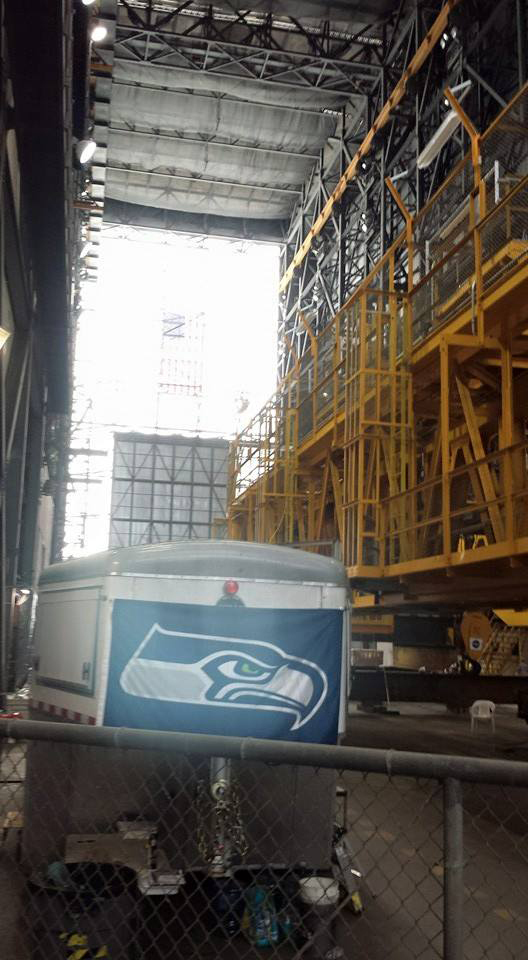
Behold space shuttle Endeavour! Now a museum piece on display at the California Science Center in Los Angeles, Endeavor's first mission was May of 1992, and her final flight was May of 2011 (STS-134, the second-to-last shuttle flight ever). When he visited the edifice during a SpaceX social media event back in 2015,Christian discovered a "12" or two must work for NASA, given the Seahawks flag inside the VAB.
By Source, Fair use, https://en.wikipedia.org/w/index.php?curid=20142420
LONG GONE: Pardon the interruption, as the saying goes. The last week has involved out of town travel, and turning me into a cyborg.
Yes!!!!!!
Ever since I saw "The Bionic Woman," based on "Cyborg" by Martin Caidin, I've dreamed of having some superior,engineered parts. Fast forward 40 years since Jaime Sommers' antics, and I've joined the club. I have a shiny, brand-new titanium hip. Sweet!
However, unlike a made-for-tv story, it's not exactly all cake and circuses getting a good ol' body part cut out and having a new one inserted. So, I've been working my way back. We appreciate your patience during this 'upgrade.'
FIRST FOTO: Space exploration fans know that last week, NASA's Juno spacecraft achieved orbit insertion at Jupiter. Today, the first photos from the probe were released!
The image above is made from some of the first images taken by JunoCam after the spacecraft entered orbit around Jupiter on July 5th.
Happily, the view shows that JunoCam survived its first pass through Jupiter's extreme radiation environment, and that it has begun to collect images of the giant, gaseous planet.
The photo was taken on July 10, when Juno was 2.7 million miles (4.3 million kilometers) from Jupiter on the outbound leg of its initial 53.5-day capture orbit.
The first high-resolution images of the planet will be taken on August 27, when Juno makes its next close pass to Jupiter.
Conceptual art from NASA FIREWORKS: Yes, we know it's Independence Day, and yes, we stood on our deck and watched the big pyrotechnics show over Lake Union after dark. But all day long, we had our eyes and minds on NASA TV, watching coverage of the spacecraft Juno reaching the largest planet in our solar system. So exciting!
The final view taken by the JunoCam instrument on NASA's Juno spacecraft before Juno's instruments were powered down in preparation for orbit insertion. Juno obtained this color view on June 29, 2016, at a distance of 3.3 million miles (5.3 million kilometers) from Jupiter. The spacecraft is approaching over Jupiter's north pole, providing an unprecedented perspective on the Jupiter system, including its four large moons. Credits: NASA/JPL-Caltech/SwRI/MSSS We watched five years ago when Juno lifted off from Cape Canaveral, destination Jupiter. (The actual launch is about the 4 minute mark in the video below.)
Five years and 1.7 billion or so miles later, Juno has reached its destination and is orbiting the giant, gaseous planet just as planned. Phenomenal!
Following Juno's successful Jupiter Orbit Insertion (JOI), NASA administrator Charles Bolden had this to say: “Independence Day always is something to celebrate, but today we can add to America’s birthday another reason to cheer -- Juno is at Jupiter. And what is more American than a NASA mission going boldly where no spacecraft has gone before? With Juno, we will investigate the unknowns of Jupiter’s massive radiation belts to delve deep into not only the planet’s interior, but into how Jupiter was born and how our entire solar system evolved.” According to Rick Nybakken, Juno project manager from NASA's Jet Propulsion Laboratory, "The spacecraft worked perfectly, which is always nice when you’re driving a vehicle with 1.7 billion miles on the odometer. Jupiter orbit insertion was a big step and the most challenging remaining in our mission plan, but there are others that have to occur before we can give the science team the mission they are looking for.”
So what's next? Per a NASA press release, "Juno's principal goal is to understand the origin and evolution of Jupiter. With its suite of nine science instruments, Juno will investigate the existence of a solid planetary core, map Jupiter's intense magnetic field, measure the amount of water and ammonia in the deep atmosphere, and observe the planet's auroras. The mission also will let us take a giant step forward in our understanding of how giant planets form and the role these titans played in putting together the rest of the solar system. As our primary example of a giant planet, Jupiter also can provide critical knowledge for understanding the planetary systems being discovered around other stars." We're looking forward to following Juno for the months to come. SUBMITTED: We had a loooooong "to do" list today. One item was (finally!) submitting an illustrated manuscript for picture book to a big publishing house. As part of the process, Annabelle had to create an online portfolio of artwork. You can see it here: https://kisky.carbonmade.com/ FUN FACT: If you Google "askew," the page results will be tilted ever so slightly. Hat tip to Annabelle for sharing this info.
EXPLORING NEW WORLDS: This afternoon, we had the pleasure of attending the out-of-this-world special Star Trek exhibit at EMP Museum. The entrance to the exhibit was dramatic.
CJ and Annabelle were definitely ready to boldy go!
These space-flown Gemini-era artifacts from NASA at the entrance let us know we were in for something special.
The Star Trek showcase included amazing artifacts, such as scripts pumped out of Gene Roddenberry's typewriter ...
Loved reading this page ...
Are you up to the Star Trek Test?!
The visual centerpiece of the main floor's display was the old bridge from the original series.
The shirts' necks and rickrack embellishments on the sleeves are a little worse for their 50 year wear, but the fabric itself is in great shape. In person, you can even see the see hand stitching on the shirts' hems.
While I have to admit the 'control panels' look dated and obviously they're the stuff of fantasy.
But boy , oh, boy, did those buttons hold magic for me when I was a kid.
And I guess they still do. :) Sulu's station is pictured below.
There were iconic original series props, including a communicator ...
a tricorder ...
a phaser ...
and McCoy's hypospray.
Uhura's dress was on display (as was the requisite ear piece).
We were happy to see this guy!
Any fan of the original Star Trek will never forget the epic Kirk v. Gorn fight.
This Kirk costume from "Mirror, Mirror" was pristine. Something tells me William Shatner loved wearing it.
The detail on its medallions was cool to see up close.
There were also costumes from Amok time, including Spock's father, Sarek. It looked a lot fancier in person that it did on a small CRT TV back in the day.
Spock's mother's dress was lovely.
Of course, Star Trek didn't end with the original series. Naturally, there were nods to The Next Generation, including rather terrifying Borg items.
And there were some interesting Data-related items, including his painting of his cat.
And his head(!). I walked over it twice before I noticed it.
We all loved this Picardigan (a fun play on words).
And we can't forget Captain Janeway of Star Trek Voyager years.
Her chair looked more comfortable than Kirk's but I loved the mid-century lines of TOS captain's chair more.
Captain Benjamin Sisko's suit was also on display from the Deep Space Nine days.
Of course, the exhibit wouldn't be complete without items from the Star Trek movie franchise, like this costume worn by Ricardo Montalban in "The Wrath of Khan."
This Klingon mask was remarkably detailed. Bet it wasn't much fun to wear, though.
Here's a space suit Spock wore in the movie series.
There were items from the most recent movies, as well, like this costume from Star Trek Into Darkness.
The exhibit has a number of really clever interactives, including a booth where you can get your Khan on!
You go into the booth, the infamous scene cues up and at the appointed moment, you pretend to scream "Khaaaaaan!" a la William Shatner/Captain Kirk.
We were amused by the updates on the screen while waiting for the video to process. ...
"Processing rage," LOL.
There was also a terrific transporter-related scene for people to ham it up in.
Two to beam down, Scotty!
Things got pretty intense. Fortunately neither of the kids was wearing a red shirt during their away mission!
Another fun spot was a chance to crawl through a Jeffries tube (how many times did Scotty have to do that?!).
Turns out the tubes are named after a key production designer from the original series.
Mr. Jeffries drew this to-scale early diagram of Enterprise and a Klingon Cruiser.
There was also a super clever "Create an Episode of Star Trek" attraction.
You could spin dials to create your story. Annabelle's featured Lt. Uhura who encountered a powerful energy being who is stealing the Enterprise.
The hero (Uhura) decides to infect the enemy computers with a virus, but discovers a computer is running things from behind the scenes, so the hero must blow up the Enterprise ...
and learns cooperation is better than fighting. CJ's story involved Captain Kirk encountering a powerful energy being who is stealing the Enterprise. The hero decided to run scans and perform experiments and finds the aliens are simply protecting their young. So the hero must attack the enemy ship, but learns all thinking beings deserve to be treated equally. I think I've seen that episode. ... There were factoids about the Star Trek universe posted here and there. I'd forgotten this fact.
There were several mentions about how diverse the cast of the original series was, and how unusual that was back when it aired.
CJ was enthralled by this mega Star Trek timeline on a wall in the exhibit.
There was a smaller, upstairs exhibit area.
The space included info about how Star Trek continues to influence popular culture.
The Star Trek exhibit took up about 90 percent of the two hours we spent at EMP today. But we didn find time to say hi to Jimi. ...
And the kids thoroughly enjoyed their time in the Indie Game Revolution space. Since our last visit, they have added this ridiculously entertaining game.
Two teams of two people play against one another. Each team is a two headed noodle, basically, trying to work together to coral a ball onto their side.
It was hysterical to watch. And speaking of hysterical, the kids always *have* to play Tenya Wanya Teens.
It appeals to only the most high minded players. :)
EMP is simply amazing.Oh, and the playground outside of it isn't bad, either.
EYES ON JUPITER: Most Americans will be thinking about barbecues and fireworks on the Fourth of July. Space exploration fans, however, will also be watching NASA TV for news about the spacecraft Juno arriving at Jupiter on Independence Day. We can't wait to see the photos and data that will be beamed some 1.8 billion miles back to Earth! This PBS NewsHour segment gives an overview of the event. And tonight we listened to sound from around Jupiter! Below, you can listen to waves measured as Juno entered Jupiter's magnetosphere on June 25, 201. Audio accompanies an animation, with the volume and pitch correlated to the amplitude and frequency of the recorded waves.
SOCIAL ANIMALS: For anyone interested in potentially attending an awesome, NASA-related event (like a launch, a rocket engine test or more), sign up to get announcements from NASA's social media team when new NASA Social opportunities are open for registration. Simply subscribe by following this link: https://lists.nasa.gov/mailman/listinfo/nasa-social-announce