Thursday, July 26, 2012

Incoming

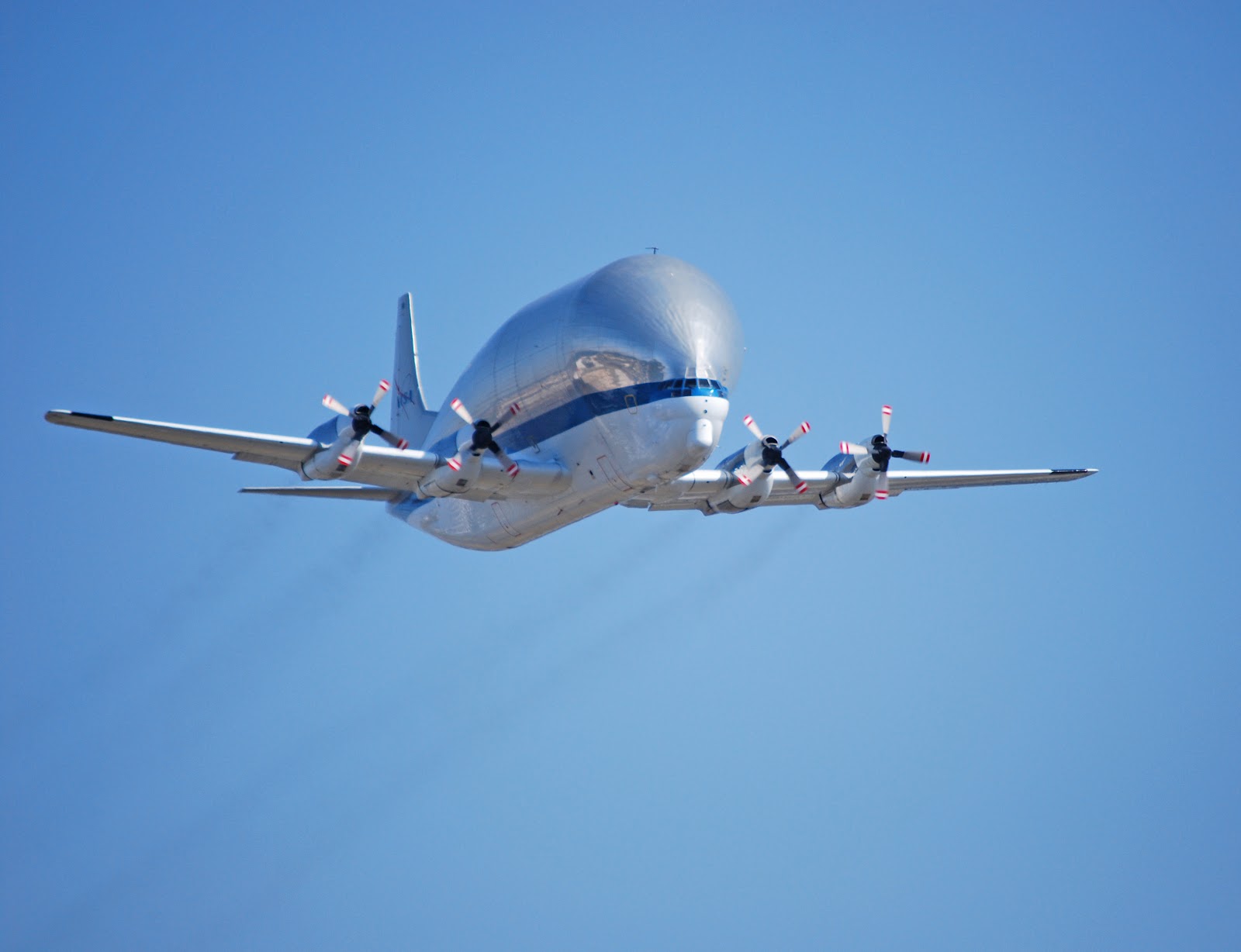
RETURN OF THE SGT: This morning Boeing Field was the place to be, as NASA's amazing Super Guppy Turbine made a return to the Emerald City. On board was the second shipment of the big ol' shuttle trainer that is being installed at the MoF. 

The Guppy, made by Aero Spacelines and the last of its kind flying, was scheduled to touch down at 10 a.m. We (Renee, Jim, Kennedy and I) arrived at the museum about 9:45. We stood out in the parking lot, looking northward, as that's the direction it came from when the kids, Christian and I went and saw it fly in a couple weeks ago.

About 9:54, I saw lights headed our way, with wispy trails of black smoke behind it. From my past experience, I immediately knew it to be the SGT, and let the people around us know it was incoming. 

 Though advance notice of the event specifically said there would be no fly over before landing, I guess the SGT pilot didn't get that memo.
See? There's no landing gear down! 
Here it comes ... 
 
and here it goes!
 
It cut through the clouds south of Boeing Field before turning north over Lake Washington ...
 before turning back southbound and touching down. 


As we stood along the fence line on The Museum of Flight's east border, the SGT rolled right past us. (In the frame above, you can see that I was shooting through a chainlink fence.)

After watching the Guppy land, we spent a couple of hours walking around the Museum of Flight. It was amazing, as always. 

As Kennedy and I left the museum, we were happy to see at that very moment they were unloading the cargo. The front of the Guppy was cracked wide open. Amazing!
And because of my awesome photography skills, you also get to see the back of Ken!

ALSO INCOMING: Tonight, CeeJ, Bee and Christian are finally returning home. I'm looking forward to seeing them, of course, Here's a pic of Annabelle during a pit stop they made in Vancouver, to visit G&G.


Mas Mars

TUNED IN TO MARS: At 1 p.m. I hopped onto the NASA NEON Webinar site to sit in on a session called. (I could see in the list of attendees that both Rick and Ken were online for it, too.)


According to webinar host Tom Estill, a NASA education specialist with 25 years of experience as a middle and high school science teacher, as far as NASA is concerned about MSL, "It's a big deal."


Well said, Mr. Estill. :) 


Estill works at Goddard Spaceflight Center in Maryland, amidst 10,000 other NASA employees, including hundreds of astronomers, cosmologists, physicists, biologist, ecologist, geologist, botanists and more. 


The first resource Estill showed us was Mars Quest Online: http://www.marsquestonline.org/  This site is a cooperative effort of several entities. There are a number of educational tools on the site, but the webinar host recommended the "Drive a Rover" as the top attraction. It's a neat game where you have to send a series of commands to the rover to get it to move and collect Mars rocks. It would be a great logic and sequencing activity for the kids (and me too!). It also teaches about degrees and estimate. He suggested it could even be played as a competition, to see who could complete a successful sequence first. Fun! 


Estill showed us a cool part of the Jet Propulsion Lab home page. If you click on the "Missions" option, you'll get a drop down menu, from which you choose "Current" and then you get to see the latest pictures coming down from the Red Planet. Right now, it's just Opportunity phoning home, so to speak, but soon, MSL will be beaming images back, too.


He suggests rather than navigating your way to the media images, you select the RAW images. Those are the latest pictures. For instance, here's the newest Navigation Cam photo from Opportunity, taken on the rover's 3121st day on Mars.  
I can't wait to see the raw images from Curiosity!


He also showed us Rock Around the Worldhttp://ratw.asu.edu/ On the front page of the site, it says: Scientists Need Your Help! Mars Scientists are asking students from around the world to help them understand the red planet. Send in a rock collected by you or your classroom from your region of the world and we will use a special tool like the one on the Mars Exploration Rovers to tell you what it's made of."  (In case you're wondering, the sample goes to scientists at Arizona State University.) Apparently after sending our rock and a data sheet in, we'll get a certificate of participation in the program, and our rock's analysis will be on a Web site. 


I can't wait to do that with the kids!


Estill said  coverage of MSL's landing will start on NASA TV at 8:30 p.m. Pacific time. He says there's a possibility they wont' know if it has landed successfully or not until about an hour after it has landed. I'm not sure he had the latest info, frankly. I had heard that before, too, but that was PRIOR to the successful re-positioning of the Mars Odyssey Spacecraft yesterday. With Odyssey's trajectory correction maneuver, it is now in a position to be the assisting satellite to transmit the first signals from Curiosity shortly after landing. 

We were also pointed in the direction of a collection of "all sorts of rad activiites" about the Mars Science Laboratory mission on a Web site called Summer of Innovation Mars Exploration site. Estill called it some of the best Mars educational activities that are out there.


He also showed us the Curiosity home page, of course. There, under the multimedia heading, I learned there is a brand new video about MSL called "The Science of Curiosity." Here it is for your viewing pleasure:


On the "Events" part of the MSL site, you can find you state and see what's going on to celebrate Curiosity's landing. On the Mars for Students part of the site, there are activities, including paper templates to build Mars observers or rovers. 


Estill also told webinar participants about a couple of live-in-person type resources, one being NASA's Solar System Ambassador Program. It's comprised of about 450 volunteers across the country who are trained by JPL engineers to bring to the public the work done by planetary explorers. 


Another group that does public outreach is the  NASA Night Sky Network a nationwide coalition of amateur astronomy clubs bringing the science, technology, and inspiration of NASA's missions to the general public. Network members share their time and telescopes to provide others with unique astronomy experiences at science museums, observatories, classrooms, and under the real night sky.


Oh, and have I mentioned that the Mars Science Laboratory will be landing soon? Today, the rover's two lithium ion rechargeable batteries are charging to 100% using the cruise-stage solar array. Countdown to landing: 12 days. Eep!

Tuesday, July 24, 2012

Roster Move

SAYONARA: What's wrong with this picture (above)? We're sitting at Safeco, watching a Mariners' game, and Ichiro's mug is on the big screen and his name is in the starting line up. But wait ... what's that he's wearing? A (dreaded/hated) damn YANKEES uniform?!?

The end of an era.

Little did I know when I bought tickets a couple of days ago for last night's game that we'd be seeing the end of an era. It was announced yesterday that Ichiro Suzuki  had been traded, to the Yankees, who happened to the Mariners' opponent that evening. Convenient, I'll have to give them that.
And so, with some degree of disbelief, we watched Ichiro warm up with his Yankee teammates. 

Wearing number 31, as 51 belongs to the one and only former Yankee Bernie Williams.
During his first at bat, the crowd gave Ichiro a thunderous ovation. You could tell he was grateful. He tipped his cap to the crowd ... 
and he bowed to the crowd behind home plate and then toward the outfield. 
And then, of course, he got a base hit in his first at bat for the Yankees. And he managed to steal second. 
And he caught a fly ball to right for the last out, as the Ms lost. 

So long, Ichiro, and thanks for the memories. I look forward to him wearing a Mariners uniform again - in Cooperstown. 

GOOD NEWS:  A NASA press release this afternoon announced that the Mars Odyssey spacecraft has successfully adjusted its orbital location to be in a better position to provide prompt confirmation of the August landing of the Curiosity rover. 

NASA's Mars Odyssey spacecraft passes above Mars' south pole in this artist's concept illustration. The spacecraft has been orbiting Mars since October 24, 2001.


Per the press release, "NASA's Mars Science Laboratory spacecraft carrying Curiosity can send limited information directly to Earth as it enters Mars' atmosphere. Before the landing, Earth will set below the Martian horizon from the descending spacecraft's perspective, ending that direct route of communication. Odyssey will help to speed up the indirect communication process." 

The reason this is such good news is that about a week ago, NASA reported that Odyssey, which originally was planned to provide a near-real-time communication link with Curiosity, had entered safe mode July 11. That mean something was wrong with it, and the mode would have affected MSL communication operations. 

Odyssey was successful re-position was accomplished by completing a spacecraft thruster burn  lasting about six seconds today. Odyssey is now operating normally, and confirmation of Curiosity's landing is expected to reach Earth at about 10:31 p.m. PDT on Aug. 5 (early Aug. 6, EDT and Universal Time), as originally planned. Hooray!

FUN WITH FOOD: This morning, I sat in on a pair of NASA Educators Online Network webinars. Interestingly, both of them involved food to some degree. 


The first one was "Classroom Lunacy: Studying the Moon." While there were a number of great resources and educational activities shared. For instance, check out this super comprehensive Exploring the Moon Educator Guide:  http://www.nasa.gov/audience/foreducators/topnav/materials/listbytype/Exploring.the.Moon.html 


But the activity I know CeeJ and Bee will be over the moon about involves using Oreos to illustrate the phases of the moon. Sweet!

The second webinar was "Food for Thought," which is apparently one of NASA's newer curricula. Here are some handy links I received while 'attending' that one. When the kids get home, we'll definitely be doing some of the suggested activities. 


NASA Food For Thought Website: http://education.ssc.nasa.gov/foodforthought.asp
Space Food and Nutrition Curriculum Guide: 


HOT DOG: I'm a wiener! I've been entering Liberty Space's t-shirt giveaway contest daily now for about a week and today was my lucky day. Can't wait to wear my new shirt!


Oh, in case you're wondering, according to a press release dated July 17, Liberty Space "is a complete commercial crew space system that includes a composite spacecraft, abort system, launch vehicle and ground and mission operations, all of which were designed from inception to meet NASA's human-rating requirements."

Monday, July 23, 2012

So Long, Sally

THERE GOES MY HERO: Today, Sally Kristen Ride, the first American woman in space, slipped the surly bonds of Earth. She was 61. 

I remember her first flight in 1983, the year I graduated from high school, well. (Then, as I do now, I can't help but wonder, what the HELL took so long when it came to getting an American woman in space. But I digress.) Ride was the perfect person for the pioneering mission. A physicist, she was wicked smart but never showy - and always a consummate professional.

More recently, I have resourced Sally Ride Science several times for educational resources for CeeJ and Bee (and me!). Founded in 2001, Sally Ride Science promotes and supports children's interest in science, math and technology, with the goal of inspiring students to think about their futures in school and beyond.

Here's a short (2 minutes) video about Sally by NASA. She talks about her historic spaceflight.
<iframe width="420" height="315" src="http://www.youtube.com/embed/RTJcpCZ5fSQ?rel=0" frameborder="0" allowfullscreen>iframe>

Though Ride (1951-2012) is gone, her legend and her inspiration will live on in perpetuity. 
1st photo of US by NASA satellite, Landsat 1 (Earth Resources Technology Satellite) launched 40 years ago today

I started the day by dropping in on a birthday party for a satellite program on NASA TV. Being celebrated was the 40-year old Landsat program, a series of Earth-observing satellite missions jointly managed by NASA and the United States Geological Service.  The first 


Landsat satellite launched in 1972, and forty years ago today, Landsat began transmitting images of Earth from space back to Earth. A record of the recent history of our planet. The data returned is used by researchers, commercial endeavours, the government, environmental management, and people who like pretty pictures (Earth as Art). 


The presser covered the Top 10 stories in Earth's recent history as seen by Landsat. One example was Mt. St Helens before and after its 1983 eruption


Here's St. Helens in 1973, not long after the Landsat program was launched.
And here it is in 1983, just after its massive explosion.
Fast forward to 2000, and you can see how the land around the volcano's crater has become forested again. 
Other dramatic Landsat images shown included Beijing's massive growth over the past 40 years, the  Amazon deforestation, images of the 650 oil wells set fire by Hussein's troops in Kuwait, the Mexico Guatemala border (with complete clear cutting on the Mexico side, and a lush forest on the Guatemalan side), the global sea level rise, Yellowstone fires, and more. 


You can read about and see the top 10 here: http://www.nasa.gov/mission_pages/landsat/news/landsat-40th-top10.html

WEBINAR: Just after the LANDSAT presser ended, it was time to tune into a NASA NEON Webinar. This one was kind of a grab bag of info about NASA and space-y stuff. Here are some of the gems I gleaned in the hour.

1) There's a Web site featuring how NASA projects/programs/missions/etc. affect your everyday life. It's called the NASA Spinoff site: http://spinoff.nasa.gov/   And if you visit NASA @ Home and City, there's a cool interactive feature where you can learn about how "space exists in your environment."  http://www.nasa.gov/externalflash/nasacity/index2.htm  It's neat-o, check it out!

Webinar host Sonya Williams also pointed us in the direction of GloVis, or the United States Geological Service's Global Visualization Viewer: http://glovis.usgs.gov/  The site has an image-based search and order tool that can be used to review the land remote sensing data inventories held at the U.S. Geological Survey (USGS) Center for Earth Resources Observation and Science (EROS). I haven't had a chance to play around with it yet, but it looks like a powerful resource.

One factoid Williams shared is that at NASA Goddard in Maryland, there are more scientists at one location than at any other spot on world. There are between 9,000 and 10,000 people working there, the majority being scientists or engineers, the majority of whom are working on  earth sciences-related projects. 
We also touched on NASA's Voyager mission. There are great images and video from the mission here: http://voyager.jpl.nasa.gov/imagesvideo/index.html  and if you check out this link -
http://voyager.jpl.nasa.gov/where/index.html - you can find out where the space probes are right this second. 


THE SOUND OF SILENCE: The campus is quiet today. Have I mentioned the students have flown the coop? They're camping until Thursday. In their absence, I'm getting my geek on - scanning, editing, cropping and correcting hundreds of archival photos. That, and I have some shiny new software - Photoshop Premiere Elements 10, a video editing program. I am feeling saucy because I have used it to successfully extract, save and make portable snippets of video from a large master file. Go me!

Friday, July 20, 2012

Heroes and Villains

WE PUT A MAN ON THE MOON: Before even going vertical this morning, R.E.M.'s song "Man on the Moon" was rolling round my brain. I knew today was the 43rd anniversary of American astronauts (Neil Armstrong and Buzz Aldrin, in that order) setting foot on the moon. Talk about an historic event. Though I remember it, it's well before CJ and Annabelle's time, so we turned to books, photos and video for them to "experience" it.


We visited the Smithsonian Website and looked at some iconic images from Apollo 11, the top one being Buzz Aldrin standing in his spacesuit (above), the sun casting his shadown on the moon's surface, with the reflections of fellow moon walker Neil Armstrong and the lunar lander in his visor.


We checked out other still shots and footage from the day, including a slideshow on YouTube featuring Apollo 11 images set to REM's "Man on the Moon" song.
We also watched a wonderful, poignant video love letter to the Apollo program from Carl Sagan. 
<iframe width="560" height="315" src="http://www.youtube.com/embed/8Xtly-dpBeA" frameborder="0" allowfullscreen>iframe>
And we spent some time re-reading a favorite book we own - "Moon Landing"- a phenomenal pop up book published in conjunction with the 40th anniversary of the first moon walk.
After all of that, the kids each wrote a little something about the event.
43 years ago, the Eagle launched in space. Three heroes were on the Eagle, which are Neil A. Armstrong, Edwin E. Aldrin Jr., and Michael Collins. When the Eagle landed, Neil A. Armstrong said "Tranquility Base here. The eagle has landed.". That quote is often used when something big happens. The reason NASA needs to send more astronauts to the moon is because if it was successful back then, it will probably be more successful now using modern technology.
Annabelle weighed in, as well.

43 years ago, the 'one small step for men, one giant leap for mankind' dream was accomplished. We had all dreamed about going to the moon, and Apollo 11 made this dream possible. Neil A. Armstrong, Edwin E. 'Buzz' Aldrin JR., and Michael Collins went to the moon. When they returned, they were welcomed as heroes. My one question is: If we could afford going to the moon then, why not now? We have advanced our technology so much we could find even more about the moon than we know now. We could drill for minerals, go into the moon craters, and even see if there ever was life there. We need more men on the moon, so we could discover more things about it. 
We need to go back to the moon because it may be hiding something that we couldn't find back then, and could find now. The moon is a beautiful place, meant for us to explore. So why stop exploring such a beautiful place? The moon is a dusty grey ball, but it means more to us than any other moon. Because this is our moon. It is our job to explore it. No man has stepped foot on the moon since 1972. We need more Eagles to land. We need more info. So we shouldn't stop exploring, no matter what. We need to step foot on that dusty, grey surface again. We need to explore, discover, and learn.

JAPANESE STYLE: After dinner, we tuned in to NASA TV to watch the launch of an H-2B rocket sending an unmanned cargo craft to the ISS. It was the first time we've watched a launch from Japan. Their launch pad at the Tanegashima Space Center is picturesque - on a peninsula surrounded by the Pacific Ocean. Here's a photo of it from a previous H-2B launch.
IMAGE: Japanese Aerospace Exploration Agency - http://jda.jaxa.jp/result.php?lang=j&id=34e0e6aeae445b619931256a0bc7b9f1
There was incredibly dense cloud coverage during today's launch, so we got to see the rocket fire for all of five seconds or so before it disappeared. But it was fun listening to the launch in Japanese. Even though I didn't understand a word they said, I could have told you it was a launch they were talking about. It's just a distinctive patter no matter the language.


DARK MORNING RISES: CJ bounded out of bed at 5:20 this a.m., raring to go with Rick to see the new Batman: The Dark Knight Rises. Because you HAVE to see it on opening day, you know, and the earlier the better. Well, unless you went to the midnight screening in Aurora, CO's Century 16 theater. :(


I had just sent CeeJ and Rick out the door with Christian (who dropped them at the Pacific Science Center's IMAX theater on his way to work) when I turned on the Internets and saw the shocking news about the massacre. I immediately and irrationally wished I hadn't sent the boys to the movie, but then I quickly convinced myself that, of course, the random awful act of violence in CO had absolutely nothing to do with any other Batman screening anywhere. 


When CJ got home, he started hearing about the killings and he couldn't get enough info about it. He started combing the Internet for stories about the shooter and his background while he was listening to MSNBC and CNN on cable. I could tell that he was trying to make sense out of it and I was trying to explain to him that there will be times in life where you just can't make sense out of the senseless. Young as he is, he isn't quite ready to accept that. Can't say that I blame him.

Thursday, July 19, 2012

In the Neighborhood

FRUITY GOODNESS: This morning we took Kirby for a loop-di-loop around the neighborhood. In our travels, we saw a variety of produce on the vine (or bush). 


The blackberries are already starting to turn from green to red and black. That's early for us. CJ and Annabelle each found two ripe enough to eat. Almost unheard of for July.
A block or so away, we came across some blueberries bushes bursting with fruit. Annabelle asked if we could eat some, but I told her tempting as it was, the bushed don't belong to us, so we'd have to settle for a photo.
As we returned home, we checked in on the ancient grapevine draping the fence to our north. Little green bunches are getting bigger. Too bad the grapes they produce are so darn sour.


CLOUD WATCHING: At 7 this morning, I tuned in to a NASA NEON Webinar about the S'COOL program. I've had a postcard on my desk about S'COOL for months now, and I've been meaning to learn more. Today was that day.
S'COOL stands for Students' Cloud Observations On-Line. It's a project involving students in  real science. Per the S'COOL Web site explanation, students "provide ground truth measurements to assist in the validation of the CERES (Clouds and the Earth's Radiant Energy System) instrument. They can also compare the surface- and space-based observations to learn more about clouds and climate."  (A NASA fact sheet about CERES is here: http://www.nasa.gov/centers/langley/pdf/70877main_FS-2002-03-71-LaRC.pdf)

Using the S'COOL Web site, classrooms check when certain weather satellites are passing over them, and then they make cloud observations from the ground. 
Some of the things students are looking at are cloud levels, cloud coverage and visual opacity. Scientists then  'remote  compare what satellites observe and what students observe.


The program teaches the "ground troops" (students) about clouds and climate how it affects their city, country, and the world.

I registered Magnolia Preparatory Academy today. We should be receiving our welcome packet via mail in a couple of weeks, and then we'll be able to access data and report our observations. Neat-o!


CAPED CRUSADER: In preparation for the premiere of Batman: The Dark Knight Rises, today the kids used a handy dandy tutorial from Andertoons.com to draw their own Batmans. Er, Batmen? 


Actually, during the coloring process, Annabelle decided hers was Batgirl, the sister of Batman. 


Tomorrow morning (as in 6 a.m. morning), CeeJ and Rick are going to see the movie on Pacific Science Center's IMAX screen. That ought to be interesting! That's really not getting up early for CJ. He's always awake by 6. Rick, on the other hand, might be dragging a bit.


FALCON REWIND: SpaceX recently released a video recapping their triumphant launch of the Falcon 9 rocket and the Dragon capsule's successful docking with the ISS.


As we watched it, when the Canada arm on the space station grabbed Dragon, Annabelle proclaimed, "That was such an epic moment." 


That it was!


Wednesday, July 18, 2012

Shrinking

ALIEN INVASION: Today, be broke out one of the prizes Annabelle won during the Home Run Derby a week or so back - an space-themed Shrinky Dinks set.


Oh, how I love me some Shrinky Dinks. I remember being absolutely mesmerized by them as a kid. It was so much fun to watch the colored plastic sheets shrink right before your eyes to about 1/3 their size. It was like magic!


Today marked CJ and Annabelle's first foray into the Shrinky Dink world. They each colored an alien and some alien accessories (spacecraft, weapons, and such). 


After they cut the shapes out from the sheets, we popped them into the oven for one hot minute and PRESTO! 


Here is CJ's alien just before and just after baking.
While CJ's alien was in one piece, Annabelle's required some assembly. 
They played with their creations for a bit after baking, and for today's writing assignment, I asked them to each write their alien's backstory. What was its name? Where did it come from? And so on. 

Here's what Annabelle came up with. ...
The Firians are a species of alien never before seen. They live on the planet Heatup (HEET-up), which is made of pure molten lava. They survive because they have made very hi-tech suits that allow them to swim in lava. They also have gloves, shoes, and the suit has a helmet attached to it. The core of the planet is made of solid metal, and they will swim in the lava and secure their homes to the core. They do this so that their homes will not drift into each other. 
The planet used to be much like Earth, until the huge volcano, Erputeon, erupted. they usually use the words lava, fire, and flame as similar sounding words. Like this: "i lava you" (i love you).
In case their suit gets a rip, it is super thick. About as thick as a astronaut's suit, except lava proof. The suit is red and orange, the colors (presumably) of lava.
Now that we know about this species of alien, we believe there might be life on Mars.
The Firians eat rocks, and have very strong teeth. They also drink oil, which is very interesting to us.
This concludes the presentation of the Firians.
And here's CJ's account ...
Didnep is a LGM (Little Green Man) who is very small. As a child, Didnep wanted to become a hero. He studied why so many disasters happen on HKHKHLHHKJHLKKHJLK (his home planet). His species is Alien. When Didnep grew in to a teenager, he figured out why so many disasters happen in his planet HKHKHLHHKJHLKKHJLK. The reason is during its early years, there was a terrorist that planed to make disasters happen, and it was successful. When Didnep became a adult, he started getting a interest in volleyball. He even used volleyballs for soccer, basketball, football, baseball, and Monkey in the Middle. The rival of his planet is the Lorsoxians
STOOD UP: This afternoon Rick and I were going to listen in on a NASA Webinar about the Kepler mission. Unfortunately, the presenter never showed up. About 20 minutes after the start time, a guy who looked to be in his kitchen, using a web cam, came on. He apologized for the gone missing instructor's absence and started trying to fill time with random NASA education stuff. 

Fortunately, the hour wasn't a total loss, as one of the resources Mr. Fill-in shared was the NASA Aerospace Education Services Project's Resources Repository. It's a place to find and share educational resources. It's searchable by topic and grade level. For instance, if you use the search term "Mars" for K-12, you'll get 30 hits returned, including everything from PowerPoint presentations about MSL to an interactive Web site about geologists' roles studying samples from planets. In other words, it's a diverse and deep resource, and it would be a fantastic tool for any educator. Cool!

ATTITUDE ADJUSTMENT: Today, we checked in on Curiosity using the amazing "Eyes on the Solar System" software available online. You can track MSL's progress (along with the movements of other spacecraft and the planets) in real time. 

Look at how close Curiosity is to its target!!! The excitement is building here!
In the multimedia section of the site, we learned that today, Curiosity's RCE-A computer, which was swapped with the backup computer yesterday, is being cold reset, or rebooted, while in online, or backup, mode. 

We also learned that work is continuing regarding uploading updated flight sequences and communications parameters for Curiosity's entry, descent and landing and surface operations to the spacecraft. Yesterday,  mission controllers completed the 21st attitude control turn on MSL. The turn adjusts the spacecraft's orientation to keep its medium-gain antenna pointed toward Earth for communications. There is just one more attitude control turn planned before Curiosity lands. 

STRUNG UP: This afternoon, Rick and Ken helped the kids change the strings on their guitars.   CJ's guitar was a quick fix; Annabelle's pink sparkly number was a bit more of a challenge, but in the end, they both got restrung. Now, the kids have no excuse not to practice!