Wednesday, February 20, 2013

Space-y Wednesday

Courtesy: NASA
FRIENDSHIP:  Today marks the  51st anniversary of Colonel John H. Glenn Jr.'s orbit around our planet in the spacecraft he called Friendship 7.

The kids and I discussed how it was a Really Big Deal, since Glenn was the first American to orbit the Earth. But we also talked about how at that point the U.S. was still viewed as playing catch up to the Soviet Union, as Yuri Garagin had orbited the Earth 10 months earlier. 

Glenn's flight was different than Garagin's, in that the NASA launch was pre-announced, live coverage was widely broadcast, and all the world was watching. At his highest, Glenn was 160 miles above Earth. He made three orbits, traveling about 17,500 miles per hour, traveling 81,000 miles in all.

One thing we learned from the newsreel was that after landing and the capsule was plucked out of the ocean, Glenn actually had to exit through the escape hatch, as the primary door wouldn't open properly. You can see it for yourself here: http://www.youtube.com/watch?v=qY87RTXzA04
EXO-LENT: In week 4 of our astrobiology class through Coursera, we've been learning all about exoplanets, or planets outside of our solar system. Yesterday, we listened to two short lectures and took a quiz, and pretty much bombed it on the first taking. :/ Fortunately, by do-over time, we had reviewed and compared notes enough to score a B+, but we still felt somewhat defeated. It was the first time we'd each gotten anything less than an A. 

Today, we were determined to get back on track. We listened to three lectures all about exoplanets, with much of the discussion being about biosignatures, or any substance used to prove past or present life. Astrobiologists use telescopes to search for biosignatures as a tool to remotely detect the spectra of planetary atmospheres. For instance, scientists study the infrared spectra being radiated by an exoplanet and look for absorption troughs or dips caused by particular gases (carbon dioxide, oxygen, ozone, etc.) . For obvious reasons, it can be hard to detect the light spectra being given off by exoplanets given they are so distant, and if they're close to their star, the star's light can overcome the planet's biosignature spectrum. And the smaller the planet is, the tougher it is to spot.

The last of three lectures we watched today covered missions to search for biosignatures. The Hubble Space Telescope discovered the first exoplanet in 2001. In 2003, the Spitzer Space Telescope found its first exoplanet.

In 2006, the French/European Space Agency mission COROT used the transit method to find am exoplanet (COROT 7B)

The Kepler has found the most exoplanets - more then 50 additional ones. It was big news in 2001 when it found two Earth sized planets orbiting a star like our own. In January of this year, NASA announced Kepler had spotted 461 new planet candidates. 

Upcoming missions are GAIA (ESA), the James Webb Space Telescope, and EChO (ESA).  
Fortunately, we each scored 100 percent on today's quiz. That's more like it!

Right after we took the quiz, I showed the kids a NASA press release I'd received via email earlier in the day. it was all about Kepler and exoplanets!
Today's big news was that Kepler mission scientists have discovered a new planetary system home to the smallest planet yet found around a star similar to our sun. 

Per the release, "The planets are located in a system called Kepler-37, about 210 light-years from Earth in the constellation Lyra. The smallest planet, Kepler-37b, is slightly larger than our moon, measuring about one-third the size of Earth. It is smaller than Mercury, which made its detection a challenge. The moon-size planet and its two companion planets were found by scientists with NASA's Kepler mission, which is designed to find Earth-sized planets in or near the 'habitable zone,' the region in a planetary system where liquid water might exist on the surface of an orbiting planet."

While Kepler-37b is intriguing to be sure, astronomers don't believe it to have an atmosphere capable of supporting life as we know it. In the NASA graphic above, Kepler-37c is slightly smaller than Venus, measuring almost three-quarters the size of Earth. Kepler-37d, the farther planet, is twice the size of Earth. 

The star around which Kepler-37b, c, and d orbit is in the same class as our sun, but it's slightly cooler and smaller. However, since the three Kepler planets shown above all orbit that star at less than the distance Mercury is to our sun, it's a safe assumption that each in the Kepler trio is a hot, inhospitable worlds. 

So today was yet another example of how our astrobiology course has immediately helped us understand news we encounter in our daily 'travels.'

BIG DIG: At noon, we listened in on a JPL teleconference all about the latest, greatest news from Mars Science Laboratory. NASA's Mars rover Curiosity has relayed new images that confirm it has successfully obtained the first sample ever collected from the interior of a rock on another planet. It's a ground breaking announcement literally, as no rover has ever has drilled into a rock beyond Earth and collected a sample from its interior.
Image Credit: NASA/JPL-Caltech/MSSS

The image (taken on Mars, today!) above shows the sample, now in the rover's scoop, which was extracted by the drill. Next up: the sample will be sieved, and portions of it delivered to the Chemistry and Mineralogy instrument and the Sample Analysis at Mars instrument.
More information about Curiosity is online at http://www.nasa.gov/msl and http://mars.jpl.nasa.gov/msl/.

Tuesday, February 19, 2013

West Seattle Way

SEATTLE CENTER: This was one of those rare moments when the sun was with us from the get go. Naturally, that just meant we were itching to get out into it all day long.

This afternoon, a bit before 2 p.m., we finally headed out. We decided to go down to West Seattle, and stroll/scoot along the waterfront pathway there. It was a good decision. :)

Above, you can see Seattle Center from the red key sign above Key Arena on the left to the iconic Space Needle on the right. In between are the white Pacific Science Center arches. Below the arches, you can see an orange sculpture, "Eagle," that's part of the Olympic Sculpture Park collection.

Here's more panoramic view of the city from our West Seattle walk today, from the Needle to downtown. Blue skies and blue Sound.
There were several points of interest along our walk. For instance, signs at and just northeast of this pier (pictured below) let us know that once upon a time, popular Luna Park stood in the area.
I can't believe we'd never heard about it before today! Built on pilings, the 12-acre park extended over Elliott Bay and was heralded as the "Greatest Amusement Park on the West Coast."

Founded in t1907, he park was only open six short years. It had a sterling pedigree, designed by famed carousel carver Charles I.D. Looff, who carved and installed Coney Island’s first carousel. The park had a carousel, of course, as well as a wooden figure-8 roller coaster. It was the era of Vaudeville, so Luna Park had two theaters. There was even a live bear pit! Here's a photo of Luna Park circa 1910.
One of the most distinctive features of the park was its Natatorium, which housed saltwater and freshwater swimming pools.
Sadly, by 1913, the park was a mess. In reading about it online, it sounds like it was a victim of mismanagement and political folly.  The rides were dismantled and shipped out. (The carousel is apparently still in operation, at Yerba Buena Gardens in San Francisco. It's now known as Zeum Carousel.)

All that remained of the amusement park was the Natatorium, which drew swimmers for the next two decades. But on the night of April 14, 1931, an arsonist's match lit the last chapter to Luna Park. The Natatorium gone, it closed forever. 

All that's left of the bright lights and big thrills are some piers only visible when the tide of Elliott Bay goes way out.

Another 'point of interest' signs we saw today told us we were standing in a spot that would have served as a vantage point to tragedy on Nov. 18, . On that evening, two miles out into the Sound from the shoreline, the steamer Dix, on its way from Seattle to Port Blakely, collided with an Alaska steamer, Jeanie.
The Tacoma-built Dix only operated for two years (1904-1906) before going down. The top heavy boat was built for one specific purpose/run - across Elliott Bay, from Seattle to Alki Point, a recreation hub for the Emerald City. Reportedly the Dix was built too narrowly - only 20.5 feet wide - which made her very unstable. During initial vessel testing, the ship was discovered to be so top heavy, 30 tons of ballast were added to help keep her upright.

On the night she went down,  Dix was serving as a relief boat for the Monticello on the Seattle-Port Blakeley run. The first mate was at the wheel. By all accounts it was a clear, calm night when Dix was inexplicably turned directly into the path of the 10x larger Jeanie, a three-masted schooner. 

As a result, 'Forty two people were carried to an early, watery grave," the sign we saw today reported. To date, that disaster remains the highest casualty count of any shipwreck in the area. None of the bodies of the victims were recovered, according to reports I read tonight. They went down with the ship.

This photo, below is taken not far from the POI sign.
The wreckage of Dix is believed to have been located in 2011. It sits at a depth of 500 feet, about one mile north of Alki Point. You can find some photos of the wreckage here: http://www.boydski.com/diving/photos/wrecks/dix/DixWreck.htm

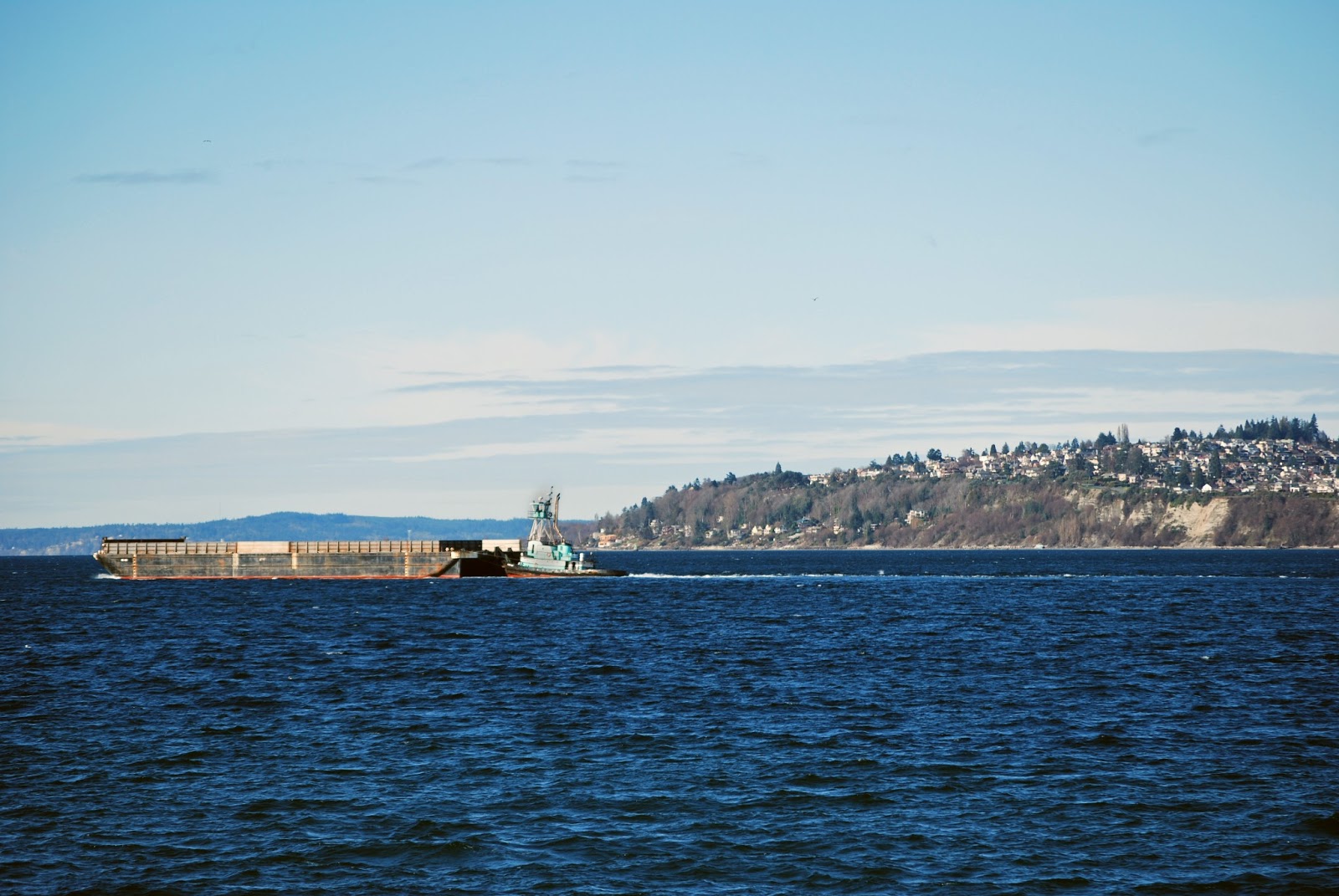
We saw nothing but mildly choppy waters and smooth sailing (or barging) during our jaunt today.
 Here's a shot across to our hill (to the left), Magnolia.
 And here we are headed back to our car. Queen Anne Hill is in the distance.


Monday, February 18, 2013

Busy Weekend


TREKKING: We scored a bike rack off Craigslist for $40 which fits nicely on our Honda's spare tire, so we gave the new rack a go and took the bikes down to the path that runs along the eastern edge of Puget Sound nearest to the west slope of Queen Anne hill.
It was a bit chillier than we were dressed for, but the scenery sure made up for it.
Along the way we encountered a waterfront exercise course. CJ gave the parallel bars a whirl.
While Annabelle enjoyed an excellent view while doing some sit ups. 
We also stopped so the kids could climb on a large art installation. Here, CJ tried to carry the old Seattle PI ball. 
And today, next to a huge grain elevator, we saw our first cherry blossoms!
CONEHEADS: Poor little pups. Kirby and Laika both went under the knife today. We took them to the vet before 9 this morning for their appointments to be spayed. When we picked them up 7.5 hours later, they were both drugged out of their heads and wearing big ol' cones, poor things.

When we brought them home, we put them on the floor on blankets. Within seconds Annabelle cooed, "Oooh, look, how cuuute! They're touching cones."

ROAD TRIP: Saturday, we made about a 350-mile round trip to Vancouver and back. Our primary reason for heading south was to visit a dear family member who was just out of the hospital. It was very good to see her, and definitely worth the drive!

While down south, we took a few minutes to visit the park that used to be in our backyard. It's the first and foremost playground CJ and Annabelle frequented for the earliest years of their lives. As we watched them clamber on, over and under the equipment with ease, it was hard to remember the days when they could barely even walk around it.

SUNDAY MATINEE:  We headed up to the good ol' Crest theater in Shoreline where you can see a 3D movie for just $4.50 (instead of $14!), and have the best popcorn in town (they use REAL butter). We went to see "Wreck It Ralph," which we had seen last fall in a sneak preview. We all loved it and were waiting for it to come to the Crest so we could go see it again. This time Rick went with us. It was a full house and there was lots of laughter and applause from the audience.

Sunday night, we started playing a new-to-us game called "Primordial Soup." It's a board game where each player is in charge of a team of amoeba. On each turn you're given biological points and your amoeba move, eat and procreate. Ultimately, you're trying to accumulate enough biological points to evolve.

It's a bit complicated, but we managed to work our way through an hour or so of it. We probably have another hour or so to go to complete it.

THREE FIFTHS: We took our second Week 3 astrobiology quizzes on Sunday. The subject matter was mostly about Europa, Enceladus, and other icy bodies in our solar system which might harbor life.

Europa, one of the four moons of Jupiter discovered by Galileo, is a candidate for life because scientists believe that below its icy, crusty surface, there is an ocean of liquid water with salinity. Scientists wonder if Europa's oceans have vents in them, like our oceans, and what the chemistry of those oceans is.
This false color image of Eurpoa was taken by NASA's Galileo spacecraft Sept. 1996-Feb 1997 at a distance of 417,489 miles. Per NASA, "The reddish-brown areas represent non-ice material resulting from geologic activity. White areas are rays of material ejected during the formation of the Pwyll impact crater. Icy plains are shown in blue tones to distinguish possibly coarse-grained ice (dark blue) from fine-grained ice (light blue). Long, dark lines are ridges and fractures in the crust, some of which are more than 1,850 miles long."  Photo courtesy - NASA/JPL/University of Arizona

Enceladus, a moon a Saturn, near its E-ring, was discovered by Hershel in 1789. Its surface appears young and reflective. When NASA's Cassini probe flew by in 2004, it captured high resolution images of plumes ejecting from the moon's south polar region. From Cassini, we know that the plumes contain water, ice, salt, methane, carbon dioxide, acetylene, propane and complex organic compounds (too complex for Cassini to sort out).
 This photo, captured on Nov. 27, 2005, shows discrete plumes of a variety of apparent sizes above the edge of the backlit moon Enceladus. This image was acquired on Nov. 27, 2005.
NASA/JPL/Space Science Institute

We also learned about other icy bodies, such as Neptune's moon Triton; Jupiter's Ganymeade, which is also believed to have salty water ocean beneath its icy crust; Pluto's largest satellite, Cheron; and Titan, the largest moon of Saturn. It has rivers of liquid methane. Titan is intriguing because perhaps it is an example of an environment where life is using a solvent other than water.
Image of Titan captured by Cassini spacecraft on May 6, 2012

Friday, February 15, 2013

Party On

HEART PARTY: Today at the community center in West Seattle where the kids attend classes on Fridays, there was a Valentine's party. We'd made superhero Tootsie Pops and "bee mine" Valentines (pictured in yesterday's blog) for the occasion. 

Kids brought in decorated boxes and they were all placed on the floor of a classroom (CJ & Annabelle's are pictured above). Come 11:45, it was time to deliver the Valentines. I was instantly regretting our decision to put kids' names on them, as some of the boxes didn't have names, some were super hard to read, and there were 50 boxes in no particular order, and lots of people milling around. Just kind of a logistical nightmare/wild hunt. It took us 45 minutes to match our Valentines with the boxes in the room, and we still didn't manage to find them all, unfortunately. 

However, the kids were very happy with their Valentines, and I was impressed by the creativity and individuality of so many of them. 

BLUE SKIES: It was a gorgeous, sunny day and we enjoyed lots of outdoor time today. Annabelle and I hung out at the playground outside the West Seattle center for an hour while CJ took his Scratch programming class (Bee's Bollywood class was canceled). 

And then this afternoon, we went for a walk up to Ella Bailey Park. It was a popular spot today, with dozens of people enjoying the sunshine. 

On our way back down the hill, we noticed a tree with pussy willows on it. We stopped to 'pet' them for a bit. 
The clear skies meant we had a nice look at the International Space Station as it flew over Seattle at 6:49 this evening. Sweet! We never get tired of spotting the station!

KABOOM!: Like millions upon millions of others around the globe, today we spent some time watching jaw-dropping videos of the meteor that hit Russia's Urals region. 
According to the Russian Academy of Sciences, the meteor was estimated to be about 10 tons and 49 feet wide. It entered Earth's atmosphere at a hypersonic speed of at least 33,000 mph and shattered into pieces about 18-32 miles above the ground. 
Read more: http://www.foxnews.com/science/2013/02/15/injuries-reported-after-meteorite-falls-in-russia-ural-mountains/#ixzz2L1b6RRZ8
LECTURED: We're winding down our week 3 lectures in the astrobiology class. Today we watched short talks about Europa, one of Jupiter's moons, and Enceladus, a moon of Saturn. Both are intriguing to astrobiologists, as both of those moons are suspected of having liquid oceans beneath their icy crusts. Naturally, one can't help but wonder if those oceans are home to any life.


Thursday, February 14, 2013

Hearty

Image Credit: NASA/JPL-Caltech/Harvard-Smithsonian
HAPPY HEART DAY: Isn't this lovely? Per NASA, "Generations of stars can be seen in this infrared portrait from NASA's Spitzer Space Telescope. In this wispy star-forming region, called W5, the oldest stars can be seen as blue dots in the centers of the two hollow cavities (other blue dots are background and foreground stars not associated with the region). 
Younger stars line the rims of the cavities, and some can be seen as pink dots at the tips of the elephant-trunk-like pillars. The white knotty areas are where the youngest stars are forming. Red shows heated dust that pervades the region's cavities, while green highlights dense clouds." 

HEART FACTORY: "When will this Valentine's business be over?" CJ lamented early this morning. 


"Not until tomorrow," I informed him, much to his chagrin. 

And so, we powered through the rest of his 50+ superhero Valentine pops. 
We definitely had a 'consumables' theme going for the holiday. For example, here's what we made for a couple of their yoga class friends - "You are the apple of my eye" attached to some Washington state apple juice.
And for the kids' yoga teacher, there was this one ...A tea tag attached to some Yogi "Breathe Deep" tea. She loved it.
For the yoga friends, we also made these cereal-themed Valentines.So, so cute (and easy)! 
And of course I made CeeJ and Bee some Valentines. They found them on their computers this morning. 
And now, thankfully, the Valentine's Day business is over. CJ will be much relieved tomorrow. :)

Wednesday, February 13, 2013

Busy Bees

PRODUCTION LINE: We did some reading and math and science today, but most of our working hours were consumed by crafting handmade Valentines.

Annabelle had chosen some "bee mine" cards, since her nickname is Bee. We got the idea from a blog called Seven Thirty Three. There, we found a free printable we used to make the bee wings (though I did modify it in Photoshop, so we got four sets of wings per cardstock sheet rather than just two - waste not, want not!).

In the tutorial we found, they used Tootsie Pops, but when we were at the store and found some yellow suckers, we thought those would be cuter and match the bee theme better. Annabelle dug through the bins to find 50 yellow ones.
She also dug out 50 red Tootsie Pops for CJ's Valentines. 

We also had to hunt down 100 googly eyes, and craft 50 pairs of antennae out of pipe cleaners. 

Once we were home, the kids 'threaded' the suckers through the wings, glued on the eyes and antennae, and drew on some smiles. 
They turned out super cute. :)

Up next were CJ's Valentines. Those involved turning Tootsie Pops into superheroes. Tonight, we made their 'masks' (out of thin colored foam sheets).
 Tomorrow, we'll affix their yellow felt capes.
Today, I also whipped up four dozen cookies for Rick's class to decorate. Tomorrow I've got to make pounds of fondant for that project, too.

Valentine's Day is a lot of work!

Tuesday, February 12, 2013

State of Affairs


STATE OF THE UNION:  The President] shall from time to time give to the Congress Information of the State of the Union, and recommend to their Consideration such Measures as he shall judge necessary and expedient... U.S. Constitution, Article 2, Section 3

Knowing tonight was the State of the Union address, the kids and I did some studying up on the history of the speech.  We read about the history of the speech on the PBS Web site, and watched C-SPAN for an hour or so ahead of the main event. From those sources we learned George Washington delivered the first 'annual message of the president' in 1790.

When Thomas Jefferson became president, he didn't like the speech. He thought it too 'royal,' and so in 1801, he sent a letter rather than address congress. For the next 100 years, other presidents followed suit. President Lincoln's 1862 letter contained "last best hope" message to Congress.

In 1913, Woodrow Wilson went back to the ways of old, delivering his annual message in a speech to Congress. It wasn't until 1945, with Franklin D. Roosevelt, that the address became know as "The State of the Union."

The speech was first broadcast on the radio in 1923 (that was president Calvin Coolidge), and the first televised State of the Union was in 1947 (President Truman). Historically, the speech had been given during the day, but in 1965, Lyndon Johnson shifted to an evening event, to attract a larger television audience.

The first time the annual speech was postponed was in 1986, because on the morning of the scheduled event, the shuttle Challenger exploded shortly after lift off.

We watched tonight's speech, and afterward, I found a transcript online. We copied and pasted it into the free word cloud program Wordle, and pasted the text in, producing the graphic at the top of the page. 


YESTERDAY ONCE MORE: Yesterday's blog was full of photos from this weekend, to the exclusion of photos from our Monday fun.

We saw some pretty camellias on a walk around the top of Queen Anne hill. 
We spent a little time down around the Pike Place Market area. There, we saw the hammering man outside the Seattle Art Museum. 
And we appreciated the pretty sight of ferries crossing the sound. 

PRODUCTION LINE: The kids have a Valentine exchange on Friday, and they need to bring 50 cards apiece with them. I showed them some fun homemade Valentine ideas from Pinterest. Annabelle decided she liked a bee-themed one, so we printed out the bodies of the bees and the kids got started cutting those out today.
CJ suggested that we go to the store and buy boxed cards for him. I vetoed that idea. :) So he's thinking we'll be making some superhero suckers. Stay tuned. 

HALFWAY THERE: Today, we listened to a total of four lectures for our astrobiology class through Coursera. Most of them had to do with the habitability of Mars. 

In the first lecture, "Habitability," we learned that in order for a planet to be habitable for life as we know it, it has to have a source if liquid water, a source of energy, a source of elements (nutrients) and physical conditions that are within the boundaries which life can exist.

We learned that the habitable zone of a solar system is planets that are neither too close nor too far from the star. And in order for a planet to be habitable, there has to be an active geochemical turnover, or ongoing energy supply, and the physical conditions need to be relatively stable over a long period of time. 

In "Search for Life on Mars," we reviewed how people have speculated about Martian life in the past - and how often they were terribly wrong. We also learned more about the early Viking probe experiments on the surface of the Red Planet.

In "Mars as a Location for Life," we learned about Mars' three Epochs, or time periods. They were Noachian, when there were many meteorite or comet impacts, and abundant water covered the planet; Hesperian, when there were lots of volcanic eruptions and the water on the planet became acidic; and Amazonian, the time when there were no longer any standing bodies of liquid. We also learned that Mars does have many of the six key elements required for life. There's carbon, hydrogen, oxygen, phosphorus and sulfate. However, as far as we know, the planet lacks nitrogen. (Maybe MSL will find some!) And there seems to be no geotechnical turnover right now (no exploding volcanoes, no plate tectonics). Presently, many think the most likely place to find life on Mars will be in the subsurface. No wonder MSL has been drilling! 

The fourth lecture was intriguingly titled "Could we all be Martians?" It talked about Panspermia, or the theory that life exists throughout the universe and it was distributed by asteroids, meteoroids and planetoids.

In order for life to be transferred from one planet to another, it has to be able to withstand being launched from the planetary surface, survive the journey through space, and survive the atmospheric entry.

WANT: We read a story online about a girl who sent her Hello Kitty doll to the edge of the atmosphere. Talk about the ultimate science experiment. The kids and I sooo want to do this! .